
OLGE: SDG & Policy Alignment
How OLGE aligns with the UN’s Sustainable Development Goals and Indian climate policy.
Overview
In 2015 the UN adopted the 2030 Agenda for Sustainable Development. It set 17 Sustainable Development Goals or SDGs. The goals aim for peace, shared prosperity, and a stable planet. OLGE focuses on the SDGs where it can offer open knowledge, skills, and partnerships. The sections below explain the links and show how OLGE helps on the ground and online.
SDG 4 – Quality Education
Target Links:
- 4.3: Ensure equal access to affordable and quality technical, vocational, and tertiary education.
- 4.7: Ensure learners acquire knowledge and skills for sustainable development.
How OLGE Aligns:
- Provides open-access educational resources on sustainability, circular economy, renewable energy, climate adaptation, and green finance.
- Supports teacher training and eco-club activities (in partnership with schools/universities) to integrate environmental literacy into curricula.
- Democratizes access to green economy knowledge, overcoming geographic and socioeconomic barriers.
SDG 8 – Decent Work and Economic Growth
Target Links:
- 8.3: Promote policies supporting entrepreneurship, creativity, and innovation.
- 8.4: Improve resource efficiency in consumption and production.
How OLGE Aligns:
- Equips individuals and MSMEs with green skills that improve employability in the sustainability sector.
- Curates practical guides for sustainable enterprises, circular economy business models, and resource-efficient production.
Creates linkages between green skills training and market opportunities in the renewable energy, waste management, and eco-tourism sectors.
SDG 9 – Industry, Innovation and Infrastructure
Target Links:
- 9.5: Enhance research and upgrade technological capabilities in industrial sectors.
How OLGE Aligns:
- Functions as an innovation-support knowledge hub that connects academic research, industrial best practices, and public policy in sustainability.
- Encourages cross-sector collaboration between academia, business, and government on green economy solutions.
Acts as a repository for case studies, policy briefs, and technology overviews to help industry stakeholders adopt sustainable practices.
SDG 11 – Sustainable Cities and Communities
Target Links:
- 11.6: Reduce the adverse environmental impact of cities.
- 11.a: Strengthen national and regional development planning for urban sustainability.
How OLGE Aligns:
- Develops knowledge frameworks for local governments to integrate sustainability into urban planning.
- Offers open resources for community-led projects in waste segregation, renewable energy adoption, green buildings, and sustainable mobility.
- Facilitates citizen education campaigns that promote urban resilience and environmental stewardship.
SDG 12 – Responsible Consumption and Production
Target Links:
- 12.2: Achieve sustainable management and efficient use of natural resources.
- 12.8: Ensure people have the information for sustainable lifestyles.
How OLGE Aligns:
- Promotes circular economy principles through open educational materials.
- Showcases product life-cycle approaches and tools for resource efficiency.
Publishes consumer guides to sustainable choices, influencing demand and supply chains.
SDG 13 – Climate Action
Target Links:
- 13.3: Improve education, awareness, and human capacity on climate change mitigation and adaptation.
How OLGE Aligns:
- Develops climate literacy resources in multiple languages to reach diverse audiences.
- Hosts public webinars and community workshops on climate resilience.
- Provides policy summaries for decision-makers to integrate science-based climate action in governance.
SDG 17 – Partnerships for the Goals
Target Links:
- 17.16: Enhance the global partnership for sustainable development.
- 17.17: Encourage partnerships between public, public-private, and civil society.
How OLGE Aligns:
- Acts as a neutral knowledge-sharing platform where government, academia, business, and civil society can collaborate.
- Partners with global and local organizations to co-create resources and expand reach.
Shares openly licensed content to promote collective progress on sustainability.
Alignment with India’s NMSKCC (National Mission on Strategic Knowledge for Climate Change)
OLGE is strongly aligned with the objectives and strategic priorities of the NMSKCC, one of the eight national missions under the National Action Plan on Climate Change (NAPCC) led by the Department of Science and Technology (DST).
NMSKCC seeks to:
- Build a national capacity for climate knowledge,
- Strengthen research and evidence-based policy, and
- Promote dissemination and use of climate knowledge across sectors and society.
OLGE’s open library framework directly complements these aims through:
- Knowledge Dissemination:
Translating climate research outputs, policy documents, and reports generated by DST, MoEFCC, and allied missions into publicly understandable resources. - Capacity Building:
Creating accessible educational modules, webinars, and digital literacy campaigns to strengthen institutional and citizen-level understanding of climate science and policy. - Data Accessibility:
Developing open digital infrastructure for climate data visualisation and public engagement which is aligning with NMSKCC’s goal of creating an integrated national climate knowledge system. - Policy Outreach:
Acting as a communication bridge between research institutions, think tanks, and state agencies to ensure that scientific findings influence public awareness and action.
Through this alignment, OLGE serves as an implementation partner and outreach extension to NMSKCC by converting complex, research-driven outputs into mass-scale literacy and awareness, thereby amplifying the mission’s societal impact.
India Policy Convergence
OLGE’s framework also aligns with:
- Mission LiFE (Lifestyle for Environment) – promoting sustainable behavior and environmental awareness.
- National Education Policy (NEP 2020) – encouraging interdisciplinary learning and integration of sustainability education.
- India’s Long-Term Low Emission Development Strategy (LT-LEDS) – supporting informed public participation in low-carbon development.
SDG | Core Link to OLGE’s Work |
SDG 4 – Quality Education | Open-access sustainability learning, teacher training, eco-club resources |
SDG 8 – Decent Work & Economic Growth | Green skills for livelihoods, sustainable business resources |
SDG 9 – Industry, Innovation & Infrastructure | Knowledge hub for sustainable industry transformation |
SDG 11 – Sustainable Cities & Communities | Resources for urban planning, resilience, and citizen action |
SDG 12 – Responsible Consumption & Production | Circular economy and resource efficiency literacy |
SDG 13 – Climate Action | Climate education, community workshops, policy literacy |
SDG 17 – Partnerships for the Goals | Cross-sector, global-local partnerships for sustainability |
Alignment Matrix
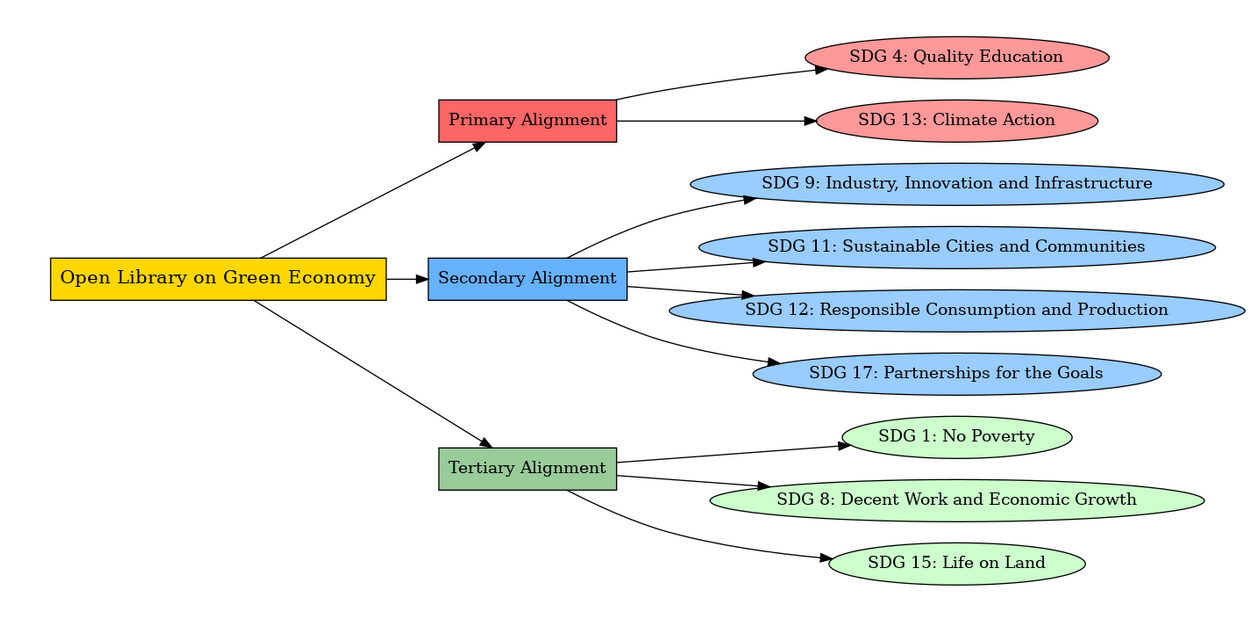
Core Focus Area | Relevant SDGs | National Missions / Policies Aligned | Alignment Type | OLGE Contribution / Outcome |
Open-Access Sustainability Education | SDG 4 – Quality Education | National Education Policy (NEP 2020); Mission LiFE | Primary | Democratises sustainability learning through free, multilingual, open-access content; promotes environmental education under NEP 2020. |
Climate Literacy & Public Awareness | SDG 13 – Climate Action | NMSKCC (DST); Mission LiFE (MoEFCC) | Primary | Translates research and policy into public-friendly explainers, increasing citizen participation in climate action. |
Digital Knowledge Infrastructure | SDG 9 – Industry, Innovation & Infrastructure | Digital India Mission; NMSKCC | Secondary | Builds an open, digital knowledge infrastructure supporting climate research, AI tools, and sustainability data visualisation. |
Collaborative Research & Outreach Partnerships | SDG 17 – Partnerships for the Goals | NMSKCC; NEP 2020; LiFE | Secondary | Creates multi-stakeholder collaboration across academia, corporates, and government for collective sustainability learning. |
Sustainable Lifestyles and Behavior Change | SDG 12 – Responsible Consumption & Production | Mission LiFE | Tertiary | Encourages responsible consumption and sustainable choices through awareness programs and citizen outreach. |
Urban & Local Climate Engagement | SDG 11 – Sustainable Cities & Communities | Smart Cities Mission; SAPCCs | Tertiary | Supports local climate literacy campaigns, city-level knowledge dissemination, and green innovation awareness. |
Green Jobs & Skills Development | SDG 8 – Decent Work & Economic Growth | Skill India; NEP 2020 | Tertiary | Promotes green economy skills through open learning and digital literacy modules for students and professionals. |
Cross-Policy Convergence Summary
National Mission / Policy | How OLGE Supports It | Relevant SDGs | Alignment Type | OLGE Contribution / Outcome |
NMSKCC (DST) | Acts as a public knowledge dissemination and climate literacy extension; simplifies research outputs into actionable public understanding. | SDG 4, 9, 13, 17 | Primary | Democratises sustainability learning through free, multilingual, open-access content; promotes environmental education under NEP 2020. |
Mission LiFE (MoEFCC) | Provides communication infrastructure and citizen engagement tools for sustainable behavior campaigns. | SDG 4, 12, 13, 17 | Primary | Translates research and policy into public-friendly explainers, increasing citizen participation in climate action. |
National Education Policy (NEP 2020) | Integrates environmental literacy and sustainability into open education systems. | SDG 4, 9, 13 | Secondary | Builds an open, digital knowledge infrastructure supporting climate research, AI tools, and sustainability data visualisation. |
SAPCC (State Action Plans on Climate Change) | Provides state-level knowledge dissemination, data visualisation, and citizen awareness platforms. | SDG 11, 13 | Secondary | Creates multi-stakeholder collaboration across academia, corporates, and government for collective sustainability learning. |
Digital India Mission | Creates digital public infrastructure for climate and sustainability knowledge. | SDG 9, 13, 17 | Tertiary | Encourages responsible consumption and sustainable choices through awareness programs and citizen outreach. |
Urban & Local Climate Engagement | SDG 11 – Sustainable Cities & Communities | Smart Cities Mission; SAPCCs | Tertiary | Supports local climate literacy campaigns, city-level knowledge dissemination, and green innovation awareness. |
Green Jobs & Skills Development | SDG 8 – Decent Work & Economic Growth | Skill India; NEP 2020 | Tertiary | Promotes green economy skills through open learning and digital literacy modules for students and professionals. |

Explore Our Library
More tools coming soon meanwhile explore our library for resources on making your organization more sustainable.