
Theory Of Change
How OLGE aligns with the UN’s Sustainable Development Goals and Indian climate policy.
Vision
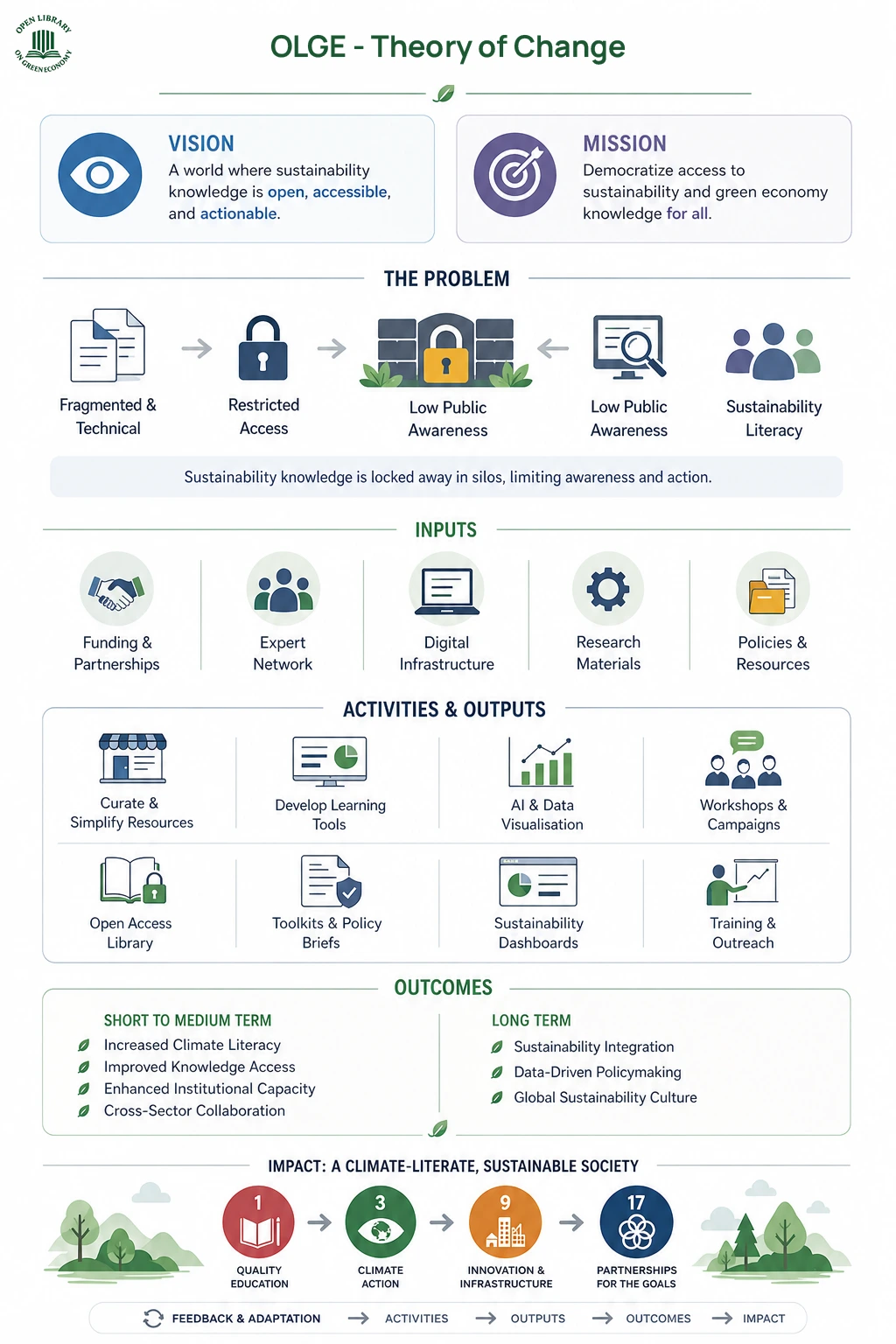
A world where sustainability knowledge is open, accessible, and actionable. Enabling individuals, institutions, and societies to make informed decisions that drive climate-resilient and equitable development.
Mission
To democratize access to sustainability and green economy knowledge by building an open digital infrastructure that connects research, policy, and people, thus nurturing climate literacy, collaboration, and transformative action across sectors.
Problem Statement
Sustainability knowledge today is fragmented, technical, and inaccessible to the broader public.
Research and data remain confined within government portals, academic silos, or consultancy reports. This limits both awareness and action, resulting in poor public understanding of environmental challenges, low policy engagement, and inadequate grassroots participation in India’s and the world’s green transition.
There is a pressing need for an open, trusted, and educational platform that bridges this gap. Translating complex knowledge into usable information for citizens, corporates, governments, and learners alike.
Change Logic
OLGE operates on the principle that knowledge accessibility is the foundation of sustainability transformation.
By converting technical climate and economic research into open educational content and practical tools, OLGE empowers individuals and institutions to make better, greener choices.
The ToC traces this journey from inputs to long-term systemic impact, as outlined below.
Inputs
- Funding support (CSR, grants, philanthropy)
- Institutional partnerships (academia, government, industry)
- Expert network in sustainability, climate policy, and education
- Digital technology infrastructure (AI, data, design)
- Research materials, open datasets, and content contributions
Activities
- Curate, organise, and simplify sustainability and climate resources.
- Develop open-access learning materials, explainers, and toolkits.
- Build AI-enabled tools for sustainability insights and visualisation.
- Conduct capacity-building workshops and awareness campaigns.
- Partner with governments, corporates, and academic institutions to expand reach and impact.
Outputs
- A comprehensive, open-access digital library on the green economy.
- Educational explainers, case studies, and policy briefs available to the public.
- Sector-specific sustainability toolkits and data visualisations.
- Published research collaborations and sponsored learning content.
- Workshops, webinars, and outreach events at local and national levels.
Short- to Medium-Term Outcomes
- Increased accessibility and understanding of sustainability knowledge.
- Enhanced climate literacy among students, professionals, and communities.
- Strengthened institutional capacity for sustainable decision-making.
- Greater alignment between government, academia, and corporate action.
Long-Term Outcomes
- A growing culture of knowledge-led sustainability transformation across India and globally.
- Integration of sustainability principles in education, governance, and business practices.
- Improved data-driven policymaking and citizen engagement in climate action.
Impact
A climate-literate, sustainability-conscious society contributing to a green economy transition that supports India’s national priorities and the UN Sustainable Development Goals, especially SDG 4 (Quality Education), SDG 13 (Climate Action), SDG 9 (Innovation & Infrastructure), and SDG 17 (Partnerships for the Goals).
Assumptions
- Stakeholders are increasingly motivated to participate in the sustainability discourse.
- Access to open and verified information leads to better behavioural and policy outcomes.
- Governments and corporates see value in supporting public education and transparency.
- Digital infrastructure in India and globally continues to expand, enabling equitable reach.
- External Enablers
- Policy alignment with NMSKCC, Mission LiFE, and NEP 2020.
- Alignment with multiple SDGs as per Sustainable Development Goals, Agenda 2030.
- National and international interest in climate action, ESG, and sustainability literacy.
- India’s growing digital ecosystem, including the Open Data and Digital India missions.
Risks and Mitigation
Potential Risk | Mitigation Strategy |
Limited funding continuity | Diversify funding base through CSR, grants, and tech products. |
Data inaccessibility or licensing barriers | Partner with public institutions for data sharing under open access frameworks. |
Low early-stage visibility | Leverage partnerships and thought leadership to build credibility quickly. |
Technological or capacity challenges | Use modular, scalable digital design and open-source collaborations. |
Feedback and Learning Loop
OLGE’s ToC is adaptive and iterative.
Impact measurement will be guided by both quantitative and qualitative indicators such as:
- Website analytics (reach, engagement, usage metrics)
- Participant feedback from training and workshops.
- Collaboration outcomes with institutions and corporates.
- Case studies demonstrating knowledge-to-action transitions.
Continuous monitoring will feed back into improving the platform, ensuring the ToC evolves with evidence, partnerships, and user experience

Explore Our Library
More tools coming soon meanwhile explore our library for resources on making your organization more sustainable.